Saturday, April 10, 2010

Asian Art Market Continues to Climb

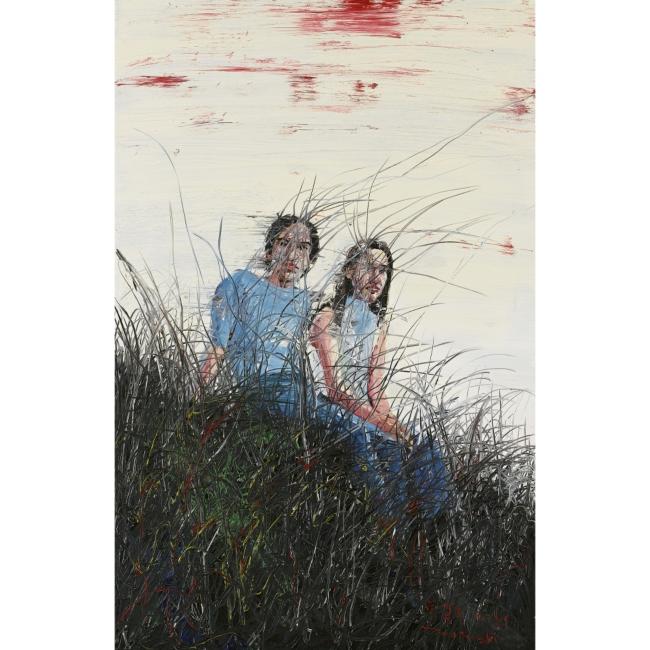
I've been following the Asian art market over the past several years and watching it grow steadily with each season. This past week's Spring sales in Hong Kong were no exception. The Sotheby's April 5 Contemporary Art sale far exceeded expectations, earning HK $130 million over its $94 estimate (see Art+Auction for a great article on the results and analysis). Among the more successful lots were a good example from Zeng Fanzhi's well regarded Mask Series and a work by Yayoi Kusama. Here are secondary pieces by each of them that caught my eye tonight when I viewed the catalogue. The third work is a painting that I fell in love with instantly, and whose hammer price was 4 times the amount of its estimate. So apparently I wasn't the only one to have this response:


Zeng Fanzhi
Couple
Oil on canvas
86 1/2 x 57 in.
Estimate: HK $2,800,000 - 3,500,000
Sold: HK $3,620,000 (USD $466,183.60)

Yayoi Kusama
Infinity Nets
Acrylic on canvas
28 5/8 x 35 7/8 in.
Estimate: HK $250,000 - 350,000
Sold: HK $475,000 (USD $61,242.12)

Jia Aili
On the Field of Hopes
Oil on canvas
64 1/2 x 104 1/4 in.
Estimate: HK $350,000 - 450,000
Sold: HK $1,940,000 (USD $250,125.70)

Saturday, March 27, 2010

Ad Reinhardt's Black Paintings

I watched a documentary on Thomas Merton this weekend, as I have been thinking about him quite a bit this week after recently discussing his life and writings with an old friend of mine. Merton was an inspiration for me when I was in graduate school many years ago. His retreat from society in the 1930's to cloistered life at a Trappist monastery fascinated me, as did his dedication to prayer, surrendering his will and what he called "false ego" to God, and finding a new freedom in serving others. He was a Catholic writer and peace activist, and later expanded his theological writings to include a "demand of all humanity by God", including those outside the Christian world. Either God has all of us, or none of us. These convictions became the foundation for my own structures of belief that I had started to build for myself at the time, and which continue to stay with me today.

Merton was a close friend of Ad Reinhardt, the abstract painter who was well regarded for his "black paintings" of the 1960s. The artist also referred to them as his "ultimate paintings" because he felt he had taken his craft to the extreme and final end of abstraction, eliminating virtually all color and form. I first saw one of these works at the Berkeley Art Museum in 2001, during a visit there with my graduate professor, the late Doug Adams, who passionately described the friendship between the two men and the admiration Merton had for these paintings.

Here are two good examples, the second of which belongs to the permanent collection at the Tate Modern in London. As their curatorial notes indicate, this painting has an underlying grid of different colored squares divided by a green central horizontal band. Seen from top left, the squares are: red, blue, red, red, blue, red. Each of these colours was mixed with black paint to give a matte surface quality. But there is no mention of what Adams pointed out to me and my fellow classmates that afternoon in Berkeley, which is that there is also a square and symmetrical cross in the layers beneath the colors, which emerges slowly and quietly as the viewer allows. Perhaps it is that element - the cross - that drew Merton's attention. It certainly does for me.

Abstract Painting
, 1960-65
Oil on canvas
60 x 60 in.


Abstract Painting No. 5, 1962
Oil on canvas
1524 x 1524 mm

Sunday, March 21, 2010

Jackson Pollock

The chief aspect of the life and career of Jackson Pollock that has always fascinated me was his self-destructiveness. He struggled for years to achieve success and fame, and when he received it, following the period in which his "drip paintings" took the world by storm and landed him the cover of Life Magazine (1949), he abruptly abandoned the style altogether. He simply stopped making them. When he returned to work a few years following the magazine article, the color in his compositions was gone, as well as the all-over dripped lines of paint. Instead, he painted in black, some abstract compositions, but mostly figurative works that recalled some of his earliest pieces.Why would he have seemingly turned on himself and his success, at the peak of his fame? Why would he have abandoned the technique of drip painting that he had literally invented, and which had changed the course of modern art history?

The answer baffles me, and probably most others, as none of us will not ever be fully aware of an artist's intentions or process.

But yet I deeply appreciate the inner struggles that Pollock must have experienced, which ultimately prevented him from fully embracing the path of long term success and longevity his life might had taken. It would have been "easy" for him to continue his drip paintings, work with a commercial gallery in New York City, and make an absolute fortune along the way, enjoying every single moment that was given him. But he wasn't an easy man. And that's the very reason why his work was so brilliant, so groundbreaking, and so spectacular to absorb in person.

So the answers are in the paintings themselves. Here are my favorites, of which, among his non-drip paintings, Guardians of the Secret at SFMOMA tops the list.

Guardians of the Secret, 1943
Oil on canvas
48 3/8 x 75 3/8 in.

One: Number 31, 1950
Oil and enamel on canvas
8' 10 x 17' 5 5/8 in.

Number 1 (Lavender Mist), 1950
Oil, enamel, & aluminum on canvas
87 x 118 in.

Wednesday, March 17, 2010

Laurie Simmons: In and Around the House


It has been a year since my last entry, and I thought that writing about Laurie Simmons would be the perfect place to begin. Simmons was one of the first women photographers in the 1970s, creating work during a decade in which photography was still becoming accepted as a viable medium for art making. "In and Around the House", her seminal work from 1976-1978, is a series of photographs that depict scenes from the interior spaces of a dollhouse. These scenes are nostalgic and traditional, and what you might expect to find within its walls. However, on closer look, some of these scenes and in particular, the placement of the miniaturized dolls, are unexpected. One critic describes them to be "about the time of memory, and about those emotions which are fundamentally temporal: longing, nostalgia, presentiment, anxiety, expectation, dread." Simmons describes her pictures of the doll (which she named Jane, after her friend, the painter Jane Kaplowitz) as looking "empty and desolate. I felt that their mood counterbalanced the cuteness of the doll, and I surprised myself by finding them acceptable."

These two images are among my favorite from the series. In the first, Jane is seated on the floor, in between the chair in which she ought to be comfortably reclined, and the television opposite it. Instead, she has been displaced from her chair and positioned to face the viewer. It is a confrontational image, and one that calls into question the entire arrangement and its underlying meaning.

The same kind of displacement can apply to the second image, which depicts a messy kitchen either before or after a meal has been prepared. The clock reads a few minutes after 6:00, so most likely it is dinner time. It is filled with suggestions of a meal, and the hint of family, but there is none. Instead, it is empty and uncomfortable to view with every detail, including the arrangement of the chairs, in which a third (positioned between the table and the kitchen counter) has either fallen down or been knocked over. It is eerie, and the events either before or after this moment is left to the imagination of the viewer.

This series of photographs was most recently exhibited at Carolina Nitsch Project Room in New York in June 2008. Simmons lives and works in New York City and is represented by Sperone Westwater.

Woman/Interior IV, 1976
Black and white photograph
5 1/4 x 8 inches
Edition of 10

Empty Kitchen, 1976
Black and white photograph
5 1/4 x 8 inches
Edition of 10

Friday, April 17, 2009

Sotheby's Contemporary Art Evening Sale, May 12, New York


The Spring auctions are around the corner, and after looking at Sotheby's beautiful new e-catalogue online tonight (check out the "relative scale" feature which completely blew me away), I am thrilled to report that it looks absolutely amazing, especially compared to the tentative and uneasy Fall offerings. What a selection, including a large-scale Jean Michel Basquiat (Lot #23: Red Man One, $3,000,000 - 5,000,000), a wonderful witty Richard Price joke painting (Lot #35: Can You Imagine, $600,000 - 800,000), and a 1986 Warhol camouflage painting (Lot #39: Camouflage, $1,800,000 - 2,500,000) that we rarely see in an evening sale. These late paintings are among my favorite of Warhol's work, because the series also included images of Leonardo Da Vinci's famous painting of the Last Supper, thereby taking a turn into the realm of religious art. They were joyfully documented by one of my thesis advisers and author, Jane Dillenberger, during the time I was studying with her. What an amazing way to discover and learn to appreciate this late period of Warhol's work.

The artworks shown pictured above are spectacular. Jeff Koons' sculpture (Lot #9: Baroque Egg with Bow, $600,000,000 - 800,000,000) is from his Celebration series, which (like Warhol's entire oeuvre) took images from our every-day life and exhalted them to high art. Here, the familiar and nostalgic Easter egg becomes a hyper-realistic, perfectly crafted, intellectually satisfying sculpture. The monumental scale and artistic precision (thanks to a factory of workers, again, like Warhol) make it even more enticing - and best seen in person. Martin Kippenberger's painting (Lot #7: Untitled, $3,500,000 - 4,500,000) is new to me, but I like him immediately. This self-portrait brings to mind the harsh, unforgiving paintings of Lucian Freud. According to the catalogue notes, Kippenberger was a master of self-portraiture, in which nothing was left sacred. In his later paintings, of which this is the best example, his self-mocking depiction of his aging body was offered up to the viewers as a stark contrast to his hero, Picasso, the ultimate master of the self-portrait.

The price points for the Koons and Kippenberger, as well as the inclusion of several Twombly drawings, a Bill Viola video and a Jeff Wall lightbox, make this particular auction pretty exciting and diverse.
Saturday, March 7, 2009

Philip Guston at NGA

I read an article in the Washington Post this morning about the newly installed Guston paintings at the National Gallery of Art (from their permanent collection), and was happy to see that it was written from the art experience/art viewing perspective. In particular, the observation was made that by opening up the skylight in the tower of the National Gallery of Art, where the Gustons are now placed, the paintings could be viewed in an entirely new way - a way in which the paint becomes not just "tones", but colors that change and communicate with the viewer as the sunlight changes position above.

The author also asserts that Guston might have actually been a colorist - and that the deep pinks, reds, and oranges of his later cartoon work are good examples of his color method. I believe that although the subject matter and figuration are remarkably different from his earlier abstract paintings, his use of color remained the same and thereby functions as a common thread. Because if you look closely at the earlier works, you will generally see the same color palette and can determine, from knowing the cartoon paintings, that the artist is the same. Both periods of his career are important and provocative - and I would imagine that seeing these later paintings under natural light would definitely change our understanding of his technique. I'll have to go check this out in person soon...

Friday, February 20, 2009

Louise Bourgeois opens at the Hirshhorn

For the past several weeks, since the Louise Bourgeois survey opened at the Hirshhorn, I have been anxious to see her work again in person. This is one artist with whose work I have a real connection because of my visit to the attic of Dia:Beacon many years ago, where some of her most important pieces are permanently installed. During that visit, I had spent quite a long time on the main level, enjoying the beautiful open, airy, naturally lit spaces and the large open format of the galleries. Paintings and sculpture by Andy Warhol, Richard Serra, Agnes Martin, Sol LeWitt - these were pieces that we took in quite easily and with much joy.

But then, I climbed up the staircase to the small, cramped rooms of the attic, without knowing what awaited me (I must have neglected to read our guidebook). And I'll never forget the sight that I came face to face with -- Bourgeois' Spider. I had seen other versions of this bronzed sculpture at SFMOMA, but this one was different -- she was crouching over a cage (which is referred to as a "cell"), inside of which stood a single empty chair. It was an immediate reaction of both sheer terror and shock. In that dark attic, standing in front of what looked like a manifestation of someone's worst nightmare, I felt completely displaced and uneasy.

But at the same time, and as has been widely written about with regard to Bourgeois' Spiders, there was another sensibility that came over me as I continued to stand there. A sense that perhaps - somehow - this creature was carefully guarding and protecting whatever lied beneath her in that cage. Perhaps she was not a predator, but in fact a protector. But a protector of what? And who (or what) resided in that chair? Was this truly a cell - a prison - or a safe haven? Or was it a repository of the unknown, the subconscious, our fears and nightmares? These possibilities are totally ambivalent, and there is no easy answer. And I believe that within this dilemma rests the mind and soul of the viewer, left to determine which one makes the most sense.

The experience of viewing this particular work was definitely a journey of the mind and soul, and drives at the very heart of my perspective about art -- that the experience of art is found in the place (or displacement) where the viewer resides - when confronted by something disturbing, shocking, or intensely beautiful, the viewer is first stunned into stillness and contemplation, and then into intellectual movement, as the viewer tries to figure out their relationship with and response to that particular work. Much of these ideas are grounded in what I studied, read, and wrote about in graduate school and I'm dying to get out my old term papers and start writing again. There is so much to say. But in the meantime, a trip to the Hirshhorn is long overdue, and I can't wait to see if a Spider awaits me there.